← newsletter
From Acting to Being
Human Inactivity for Environmental Rest: While We Contemplate, Can the Environment Rest?
posted on: 2025.11.01 [original release: 2024.09.17]
This is an audio essay I made as part of the Art & Environment Master program I did in Ireland. My class was lucky to present at IMMA’s 2023 Earth Rising Festival. Hope you enjoy the journey.
From Acting to Being
Human Inactivity for Environmental Rest: While We Contemplate, Can the Environment Rest?
An Audio Essay by D. Martins
Transcript
[Ring tone, network interference]
*
Hello?
Oh hi!
Welcome, dear listener.
Pick a spot to rest while you listen to this humble essay, or move around if you prefer. Feel free to touch and caress your surroundings. You can close your eyes, or rest your gaze or scan your environment. Whatever your body needs right now. Just make sure to tune in and let your body guide your choice. Rest comes in many forms. And whatever you choose, my voice will stay with you. You can pause or stop me anytime you like.
We have many senses, beyond the commonly known five there's also spatial awareness, balance and internal sensing, like becoming aware that you're hungry or cold. Our senses is what allow us to perceive the world, they translate the world into information useful to our survival. Sometimes my senses get overwhelmed by the constant stream of input coming my way. That's when rest becomes imperative.
~ ~ ~
My favourite spot to rest is the beach. There's nothing more soothing to me than to walk barefoot on the edge of the water. The sound of the waves, the texture of sand and rock beneath my feet... I like to drag my feet leaving marks that quickly vanish behind a dying wave. I was here. And then I was gone. There's something calming to me about such impermanence. "Leave no trace behind." It means to care for an environment, a pledge to not damage a place.
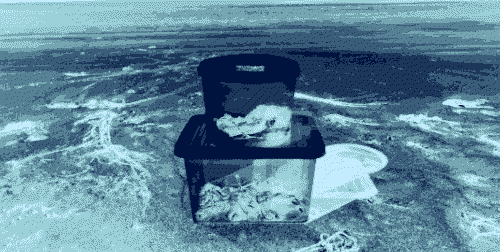
These days I find myself collecting trash washed ashore whenever I visit. It's a mix of fishing waste and other human debris. Scraps of fishing nets strangling seaweed remind of how sea-life chokes on our collective sin. The tiny scraps of plastic remind me how sea-life fills their belly with our collective sin. I call it our collective sin, yes. Is that fair? Maybe that's beyond the point. I call it a sin, because our environment is sacred. What else could you call it when our lives are supported by and depend on it. We evolved and are therefore attuned to it. Our minds and bodies thrive here. When I visit the beach, I'm comforted by its nurture, it's a bodily experience, like being cuddled by a loving caretaker.
In moments of exhaustion, I've often wondered, could the environment be itself exhausted too? How could it not be when we constantly inundate it with toxins and poison? The beach trash I collect is but a fleeting glimpse of this. We have been polluting without rest for a very long time now. We barely ever give the environment a break. So these days I wonder instead, can the environment rest?
~ ~ ~
The New Oxford American Dictionary defines rest as: “an instance or period of relaxing or ceasing to engage in strenuous or stressful activity.”
In his book Vita Contemplativa, that followed Burnout Society, Byung-Chul Han defends that in a society that champions production and relentless activity, “doing” is mistaken for “being.” He makes the case for contemplation as the bedrock of “being.”
In the first chapter, “Views of Inactivity” he defends inactivity as a crucial element to “being.”
" TheinactivityinvolvedinanydoingiswhatmakesthedoingsomethinggenuinelyhumanWithoutmomentsofpauseorhesitationactingdeterioratesintoblindactionandreactionWithoutcalmanewbarbarismemergesSilencedeepensconversationWithoutstillnessthereisnomusicjustsoundandnoise. "
Wait, let's try that again: "The inactivity involved in any doing is what makes the doing something genuinely human. Without moments of pause or hesitation, acting deteriorates into blind action and reaction. Without calm, a new barbarism emerges. Silence deepens conversation. Without stillness, there is no music – just sound and noise."
…did you perhaps take for granted those moments of stillness in-between each word only to consciously value them now?
Further, in chapter three, "From Acting to Being”, Han says: "Contemplation is opposed to production. Contemplation engages with what is unavailable yet already given. Thinking is always in the mode of reception."
Might be environment be allowed to rest when we ourselves as a society allow ourselves to dwell in contemplation and resist the relentless need to constantly produce? To do so, might allow the environment to take a break from our constant exploitation. Our obsession with production forcefully engages the environment in constant “strenuous” and “stressful” activities.
I could go on, dear listener. But instead I’d like to give you something much more valuable: a few minutes of rest. For the next few minutes, allow yourself to just be and contemplate. I’ll do the same, so contemplate with me. What that looks like will be different for each individual. Some of us like to be still, while some of us like to move. I’ll say goodbye when our time is up.
[Beach waves and sea birds; approximately 8 minutes]
~ ~ ~
[Deep breath]
Dear listener, our time together is up. I hope you will consciously allow for more moments of contemplation in your life after we part ways.
Until we our paths cross again, all the best and lots of rest.
[Network interference, disconnect tone]
*
References
- Han, Byung-Chul. 2023. Vita Contemplativa. Polity Press.
- New Oxford American Dictionary. 2010, 2023. Oxford University Press, Inc.
Thank you for listening.